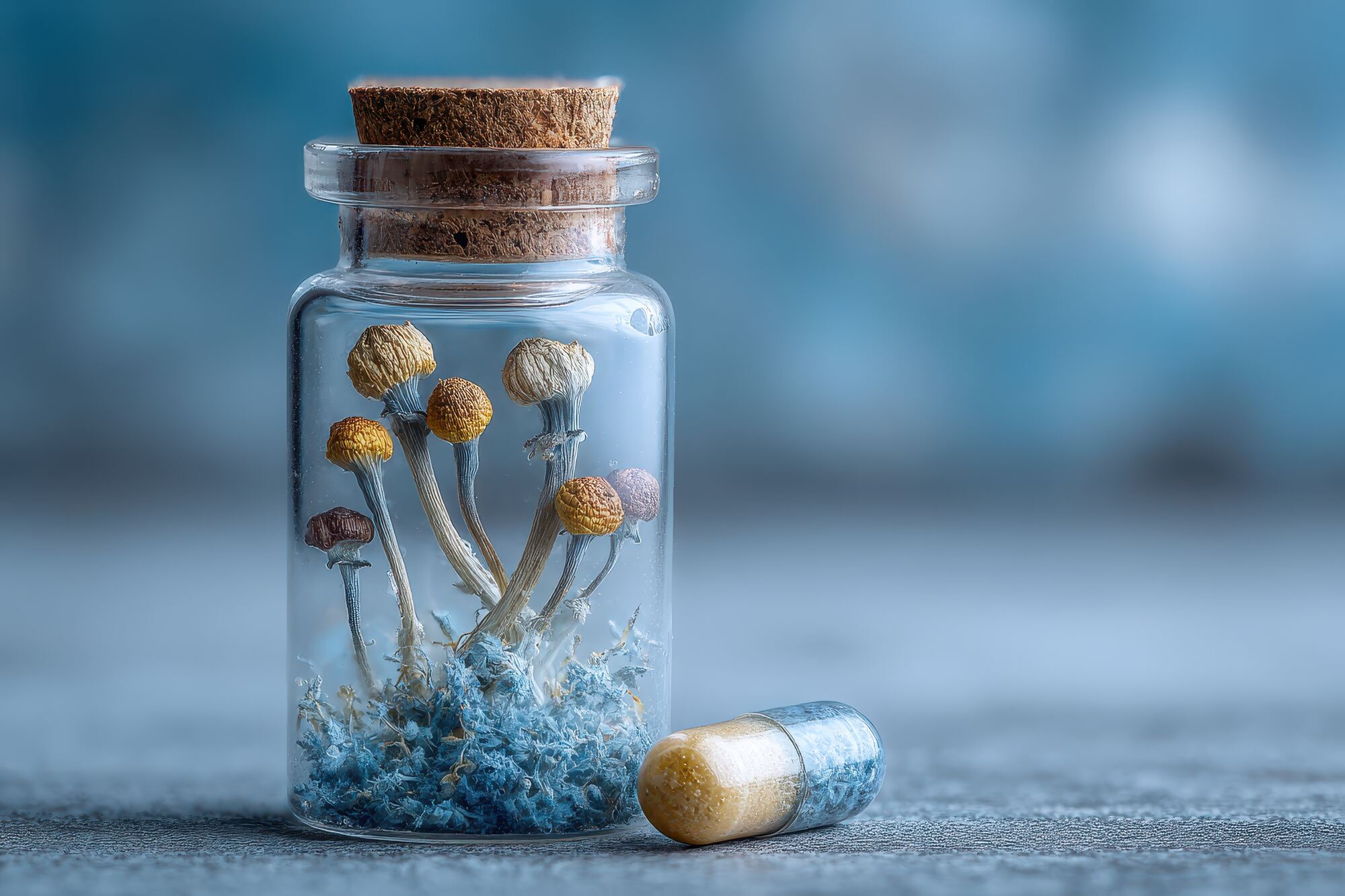
Genus at a glance
| Field | Detail |
|---|---|
| Classification | Genus |
| Family | Hymenogastraceae |
| Described species | ~300 (≈ 140–160 psychoactive) |
| Spore print | Dark purple-brown to purple-black |
| Distribution | Cosmopolitan — every continent except Antarctica |
| Habitat | Wood debris, dung, grassland soil, leaf litter, moss; boreal to tropical |
| Key alkaloids | Psilocybin, psilocin, baeocystin, norbaeocystin, aeruginascin |
Overview
Psilocybe is the central genus of psilocybin-producing fungi and the one most people picture when they hear "magic mushroom." It holds the large majority of documented psychoactive species, the ones most important to research, traditional use, and the contemporary clinical revival. Originally lumped into Stropharia, the genus was reorganised by Paul Kummer in 1871 and substantially redrawn by molecular phylogenetics in the 2000s, which split the bluing (psychoactive) species from the non-bluing ones and confirmed Psilocybe as a natural, monophyletic group built around psilocybin production.
The defining biochemistry is a compact cluster of four genes (PsiD, PsiK, PsiM, PsiH) that synthesises psilocybin from the amino acid tryptophan. This cluster was fully characterised in 2017 and is the molecular signature of the genus. Visible field traits that recur across psychoactive species are a dark purple-brown spore print, blue bruising where the flesh is damaged (psilocin oxidising in air), a hygrophanous cap that changes colour as it dries, and growth on rich, decaying substrates.
Documented species
These are well-characterised psychoactive species with published chemistry and a confident taxonomic description.
| Species | Notes | Distribution |
|---|---|---|
| P. cubensis | The most cultivated and studied species; moderate potency, large fruit bodies | Pantropical |
| P. semilanceata | The "liberty cap"; small, grassland-dwelling, high psilocybin by weight | Europe, N. America |
| P. cyanescens | "Wavy caps"; wood-chip species, very potent | Pacific NW, Europe |
| P. azurescens | Among the most potent species recorded; coastal dune grasses | Oregon coast (introduced elsewhere) |
| P. mexicana | First species Albert Hofmann isolated psilocybin from (1958) | Central America |
| P. caerulescens | "Derrumbe"; used in Mazatec ceremony | Mexico, southern US |
| P. tampanensis | Source of the "Philosopher's Stone" sclerotia | Florida, lab strains |
Under-documented & emerging
The true diversity of Psilocybe is far from settled. Tropical regions — especially Mesoamerica, the Andes, Central Africa, and Southeast Asia — continue to yield species new to science, and DNA barcoding regularly shows that a single "species" name has masked several distinct lineages. Many described taxa have never had their alkaloid content measured, so their psychoactivity is inferred from the bluing reaction rather than confirmed in the lab. Recent fieldwork in Mexico and southern Africa has added previously undescribed bluing Psilocybe almost every year, and population-level genetics of even common species like P. cubensis is still being worked out. The realistic picture is a genus whose documented count keeps rising and whose chemistry is only partially mapped.
How to read this
These profiles are educational. We do not publish foraging or identification guidance — several Psilocybe share habitat and appearance with dangerous look-alikes such as deadly Galerina, and field identification is genuinely hazardous.