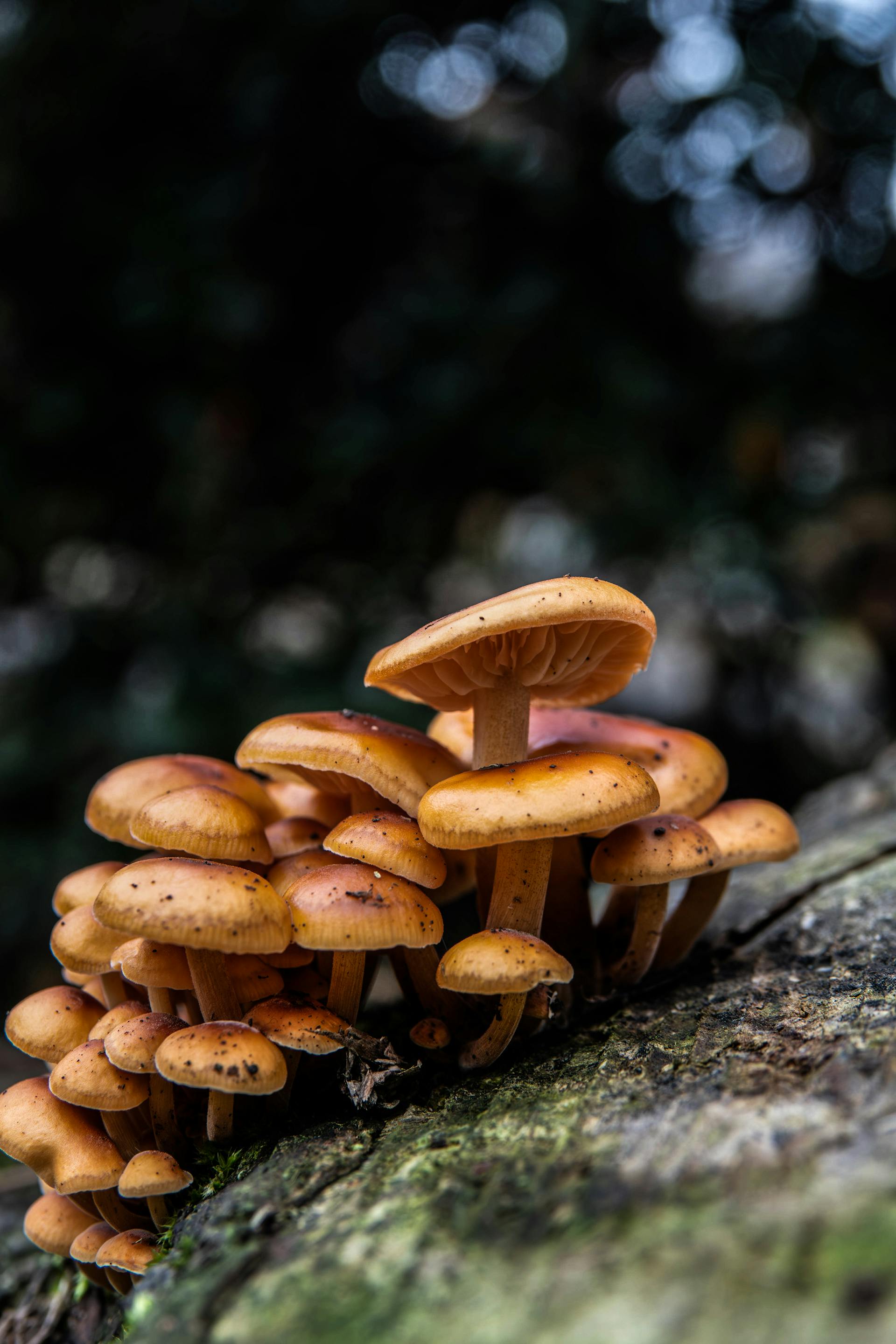
Genus at a glance
| Field | Detail |
|---|---|
| Classification | Genus |
| Family | Hymenogastraceae |
| Described species | ~200 (a minority psychoactive) |
| Spore print | Rusty orange to bright rusty brown |
| Distribution | Worldwide, common in temperate forests |
| Habitat | Decaying conifer and hardwood — logs, stumps, buried roots |
| Key alkaloids | Psilocybin, psilocin; bis-noryangonin and hispidine (styrylpyrones) |
Overview
Gymnopilus — the "rustgills" — are wood-decay mushrooms named for the rusty-orange tone of their caps, gills, and spore deposit. Most of the genus is non-psychoactive, but a subset produces psilocybin, and the genus is notable for also making styrylpyrones (the same pigment family found in Phellinus medicinal fungi), giving some species a distinctly bitter taste. The rusty spore print is the quickest separation from the dark-spored Psilocybe and Panaeolus.
Psychoactive Gymnopilus tend to be larger and more conspicuous than the small brown Psilocybe, often fruiting in dense clusters on dead wood. Their psilocybin production is evolutionarily independent of Psilocybe — an example of the same chemistry arising convergently, likely through horizontal transfer of the biosynthetic genes between fungi sharing wood substrates.
Documented species
| Species | Notes | Distribution |
|---|---|---|
| G. junonius (G. spectabilis) | Large, showy "big laughing gym"; psilocybin reported in some populations | Temperate worldwide |
| G. luteofolius | Reliably psychoactive; colourful, clustered on wood chips | N. & S. America |
| G. luteoviridis | Documented psilocybin producer | North America |
| G. purpuratus | Bluing, psilocybin-positive | S. America, Europe (introduced) |
| G. dilepis | Tropical, scaly cap; reported active | Asia, Australia |
Under-documented & emerging
Gymnopilus is taxonomically messy. Chemistry varies dramatically between populations of the same named species — G. junonius from one continent may contain psilocybin while specimens from another contain none — so single records should not be generalised. The genus is under-sampled in the tropics, where many species are known only from a handful of collections and have never been chemically tested. Distinguishing active from inactive species in the field is unreliable, and several toxic Cortinarius relatives share the rusty-spored, woodland niche.
How to read this
Educational profile only. The bitterness and population-variable chemistry of Gymnopilus, plus toxic rusty-spored look-alikes, make field identification a task for trained mycologists.