Genus at a glance
| Field | Detail |
|---|---|
| Classification | Genus |
| Family | Bolbitiaceae (formerly Coprinaceae) |
| Described species | ~120 (a minority psychoactive) |
| Spore print | Jet black to purple-black |
| Distribution | Cosmopolitan; richest in tropical & temperate grassland |
| Habitat | Dung of large herbivores, manured and grassy soil |
| Key alkaloids | Psilocybin, psilocin; some species also serotonin/urea derivatives |
Overview
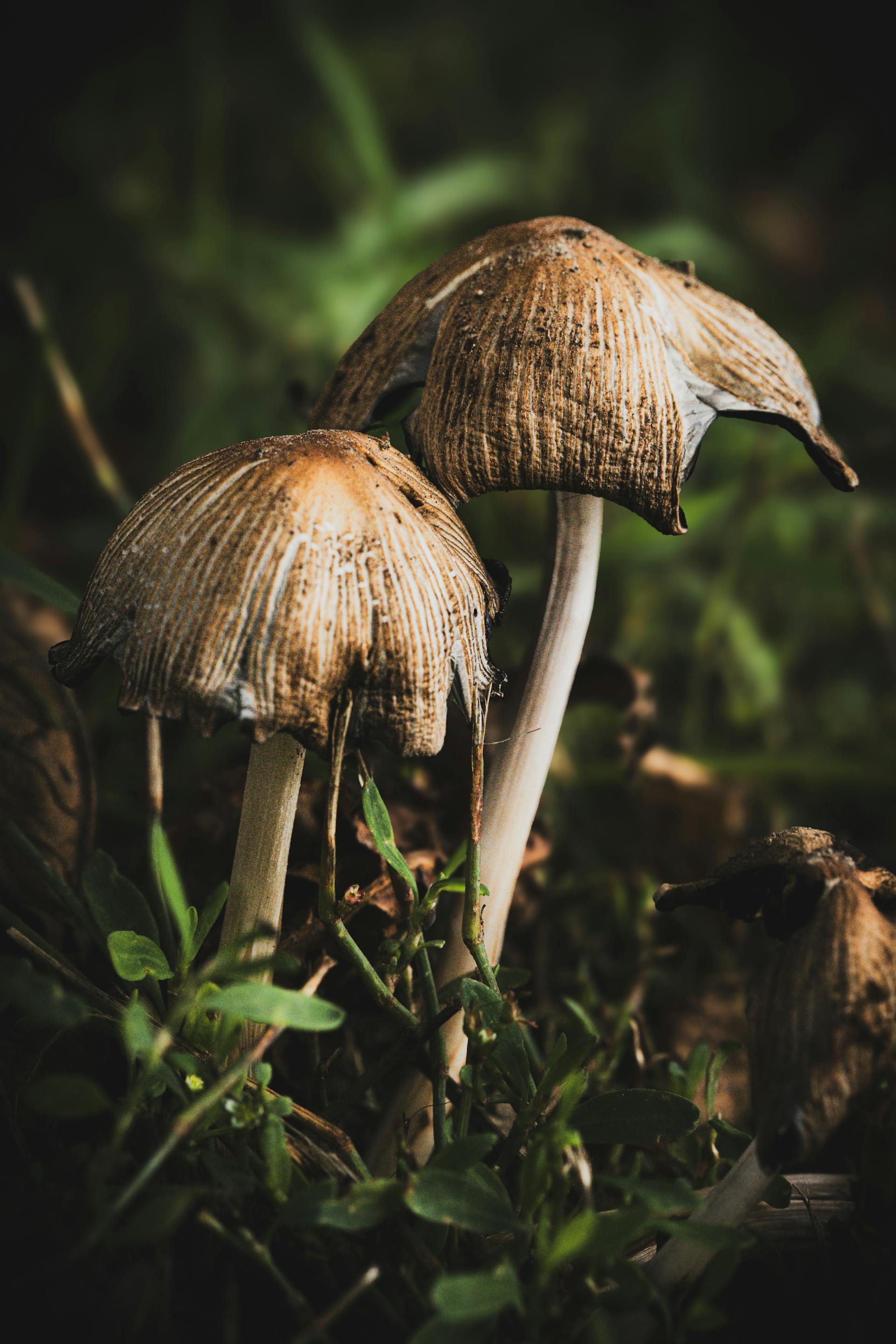
Panaeolus ("mottlegills") are small, slender, dung-loving mushrooms with mottled grey-black gills and a jet-black spore print. Most are harmless decomposers of manure and rich soil; only a minority produce psilocybin, but those that do can rival potent Psilocybe. The coprophilous (dung-dwelling) habit is ecologically telling — dung is a nutrient-rich, fiercely contested substrate, and psilocybin production appears repeatedly in fungi that colonise it, supporting the hypothesis that the compound deters fungus-eating insects.
The genus sits taxonomically apart from Psilocybe — closer to the inky-cap lineage — so its psilocybin is, again, convergent. The clearest separation from Psilocybe in the field is the spore print: jet black rather than purple-brown.
Documented species
| Species | Notes | Distribution |
|---|---|---|
| P. cyanescens (Copelandia) | Highly potent; "blue meanies"; strong bluing | Pantropical |
| P. cinctulus (P. subbalteatus) | Common, mildly active, weedy in compost | Temperate worldwide |
| P. tropicalis | Potent tropical species | Tropics |
| P. bisporus | Two-spored, active, weedy | Cosmopolitan (introduced) |
| P. africanus | African dung species, reported active | Central Africa |
Under-documented & emerging
The line between active and inactive Panaeolus is blurry and under-studied. Many species have never had alkaloid assays, and the genus is taxonomically unstable — the segregate genus Copelandia has been merged into and split from Panaeolus repeatedly. Tropical dung communities in Africa, South America, and Southeast Asia almost certainly contain undescribed psychoactive species, since collecting effort there is low and dung fungi fruit briefly and unpredictably. Even potency within a documented species varies widely with the host animal's diet and the substrate.
How to read this
Educational profile only — non-psychoactive and psychoactive Panaeolus grow side by side in the same pasture, so the genus is a textbook case of why field identification is difficult and risky.