Most of the people reading clinical research are not researchers. They are reporters chasing a deadline, patients hoping for a door that might open, family members reading at two in the morning, policy makers, and plain curious people trying to square a complicated study with a headline that flattened it. And here is the thing. The distance between what a study actually found and what the coverage swears it found can be enormous. In psychedelic research that distance yawns wider than almost anywhere, which is why it makes such a good place to learn.
So, a practical guide to reading a trial paper. Not a methods textbook, nobody needs another one of those. Think of it instead as the running mental checklist that careful clinicians, methodologists, and the better science journalists carry around without quite noticing they do, the questions they ask almost on reflex to work out what a study can carry and what it cannot. Psilocybin trials are the worked example all the way through, partly because they are recent and readable, partly because they put the typical machinery of a trial in plain view. The habits travel, though. Point them at a cardiology paper or a psychiatry paper and they do the same job.
One thing above all the rest. If everything else here slides off and you keep a single sentence, keep this one. The most important part of a trial paper is almost never the Results. It is the Methods. The Results tell you what happened. The Methods tell you whether what happened means anything at all.

Start with the question
Before your eyes even touch the abstract, you should be able to say, out loud if that is what it takes, what question this paper is trying to settle. Sounds obvious. It really is not. The usual move is to dive into the abstract, swallow a number, feel something about it, and never loop back to ask whether that number answers the thing you actually wanted to know.
A trial can answer questions of a very particular shape. In patients with condition X, does treatment Y beat treatment W, or a placebo, on measure Z, over a stretch of time T. Which patients. What treatment. What outcome. Measured against what. For how long. That little box is the whole of what one study gets to speak to. The questions people actually carry in with them are softer, bigger, and mostly unanswerable in a single paper. Will this work for me. Should it be the standard everyone gets. Is it safe for the general public over years and years. Those need a pile of studies, built differently, argued over time, and they almost never fall out of one result. So name your hope before you start. Decide what you want the paper to tell you, then watch, line by line, for whether the thing was even built to tell you that. More often than not it was not, and catching that mismatch early is the most useful move in the whole business.
Read the methods first
Most people read a paper the way it was printed, top to bottom, abstract to discussion, like a story with a beginning and an end. Trained readers cheat. They skim the abstract, then jump straight to the Methods, for a blunt reason. Until you know how the thing was run, the results are just numbers with nothing attached to them. A handful of elements in that section earn slow, suspicious attention, so take them one at a time.
The population first. Who actually got studied, let in by which criteria, kept out by which others, and looking like whom. Psilocybin trials routinely screen out people with a personal or family history of psychotic disorders, plus cardiovascular disease, pregnancy, and active substance use disorders. Sensible, careful, defensible. It also means the trial has nothing to say about any of the people it turned away at the door. A depression study that excluded psychotic vulnerability does not stretch to cover depression that comes tangled with psychotic features. That is not a flaw in the work. It is a fence around what the work is allowed to claim, and the fence matters.

Then the intervention. What was actually given, at what dose, on what schedule, in what room. This is where psilocybin research gets slippery, because the intervention is almost never just the drug. It is a bundle. Screening, preparation sessions, a long supervised dosing day with trained people in the room, integration afterward. Call the whole package "psilocybin" and you have quietly misdescribed what got tested.
The comparator next, and read it closely, because this is where a lot of impressive results quietly inflate. What did the control group actually go through. An untreated waitlist is a world away from an active drug. A sliver of psilocybin dressed up as a placebo is not a real placebo. A niacin pill that makes you flush is not an inert sugar pill. The comparator is the ruler the effect gets measured against, and a flimsy ruler makes everything look bigger than it is.
Randomization. Were people sorted into groups by genuine chance, or by some softer process. Real random assignment is the main thing keeping the groups comparable before anyone gets treated. Drop it, and you are into observational studies, open-label single-arm designs, retrospective digs through old records, all of which say much less about cause and effect than they often seem to.
Blinding, which has its own quiet traps. Did the participant know which arm they were in. Did the staff handing over the dose know. Did the people scoring the outcomes know. Three separate questions, and the single, double, triple labels are just shorthand for who was kept in the dark about what. Here is the catch that haunts psychedelic research specifically. At any real dose, blinding basically collapses. The participant knows. The staff usually know too. You feel a high dose of psilocybin, and so does the person watching you feel it. That broken blind is a hard ceiling on what these trials can honestly conclude, and no amount of careful design fully patches it.
And the outcome measures. What got measured, and how. A self-report scale is wide open to expectancy, to people feeling what they hoped to feel. A clinician rating drags in rater bias unless the rater was blinded. A biological readout is harder to fudge but may have little to do with whether anyone actually felt better. The instrument you pick bends the apparent result before a single patient is enrolled.
The sample size conversation
People love to ask whether a sample was big enough, and the honest answer is the unsatisfying one. It depends. It depends on how large the effect is and how noisy the outcome is. A huge effect in a quiet, low-variability measure can show up clearly in a tiny group. A modest effect buried in a noisy one might need hundreds, even thousands, before it surfaces at all. Most trials are powered, in the statistical sense, to catch an effect of a chosen size with a chosen probability, and the Methods usually carry a sample size calculation spelling out what the study was built to detect. Read it. People skip it constantly, and it is exactly where the trial tells you how much it can promise.

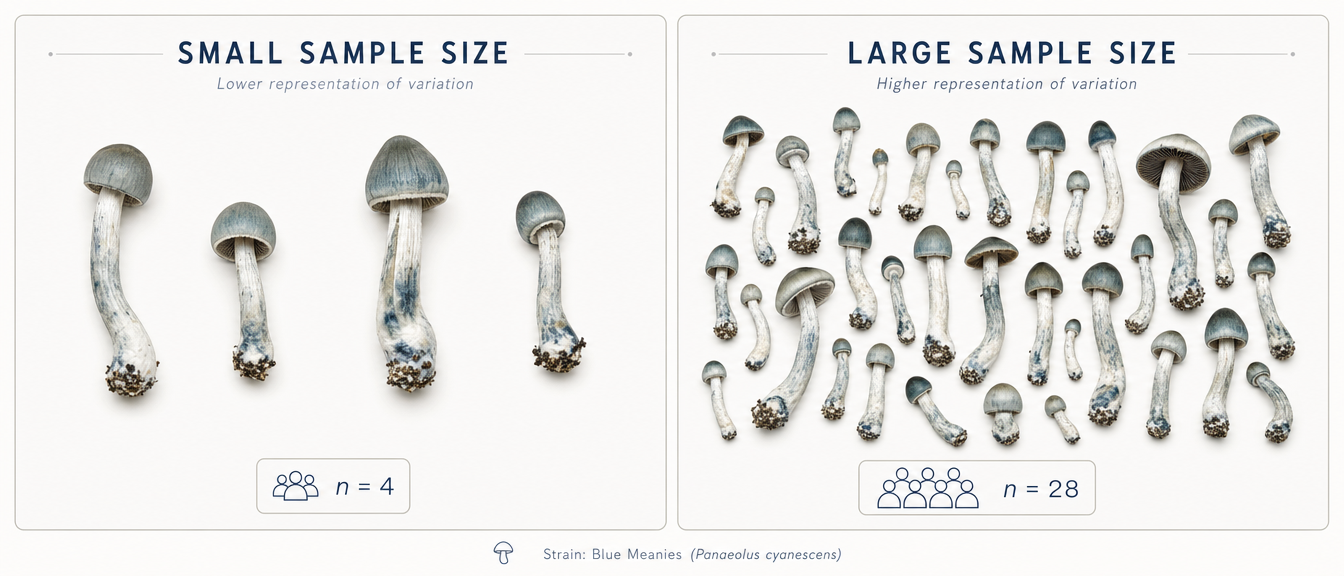
Psilocybin trials have tended to run small. Often under fifty people. Sometimes under twenty. Small carries consequences that stack up fast. Only big effects show through. The effects that do show get their size exaggerated. Stray chance findings sneak in more easily. And subgroup questions die on contact, because slice a small group into smaller pieces and there is nothing left to learn from. None of which makes a small study worthless. Pilot and feasibility studies are supposed to be small. Their entire job is to answer a narrow question, whether a bigger trial is even worth building. The trouble starts later, when a modest little pilot gets written up in the press as though it had settled the enormous questions only a large trial could ever touch.

What the results actually say
When you finally do reach the Results, a few small habits pay off. Read the numbers, not the sentence wrapped around them. The prose frames the data the way the authors see it, while the tables and figures hold the data plain. Sometimes the data is stronger than the wording lets on. Sometimes it is weaker. Reading both, and trusting the tables, lets you form a view that is yours rather than theirs.
Watch effect sizes, not just whether something cleared statistical significance. Significance only tells you a difference is unlikely to be pure chance, given the sample. It says nothing about whether the difference is big, or whether it would matter to a single living patient. Pile up enough participants and you can make a vanishingly small difference statistically significant, and it can still be far too small to feel.
Look hard at the spread. Means and medians give you the middle of the response, but standard deviations, interquartile ranges, the actual shape of the distribution, tell you whether everyone clustered near that middle or scattered all over. Psychiatric outcomes scatter. A lot. And a tidy average can hide the truth that some people transformed while others felt nothing whatsoever. Check the dropouts too, and how the missing people were handled, because the ones who walk out early often differ in systematic ways from the ones who stay, and the choice between an intention-to-treat analysis and a completer analysis can swing the result more than people expect. Then read the adverse events with the same attention you gave the wins. A paper that lingers on benefit and waves off difficulty is telling you only half of what happened. Even the wording gives the game away. A breezy "mild and transient" can paper over things the participants themselves found genuinely rough.
The discussion section
The Discussion is where the authors get to interpret, to set their findings beside everyone else's, and to own up to the limits. It is also, predictably, where the prose gets its most hopeful. Two questions cut through it.
First, what do the authors themselves name as limitations. The conscientious ones lay them out without flinching. If the limitations paragraph is short, breezy, and a little defensive, that is a tell. If it is long and genuinely candid, the whole paper earns some trust back. The stronger psilocybin trials tend to carry strikingly thorough limitations sections, one of the quieter marks of good work in the field. Second, do the conclusions actually grow out of the data. Hold the specific claims in the Discussion up against the specific numbers in the tables. The gap tends to open near the end, in those closing paragraphs that drift off toward grand future implications, and learning to feel that gap widen is most of what reading critically even means.
Conflicts of interest and funding
Modern trials mostly get paid for by someone with money riding on the answer. That is not, on its own, proof of anything shady. It is just a reason to keep your eyes open. Check who funded the study, who signs the authors' paychecks, and who owns the patents on whatever was tested. It is usually all there at the end, under headings like conflicts of interest or funding sources, where fewer people bother to look.
An industry-funded trial is not automatically suspect. But across a lot of medicine, industry-funded trials report positive results more often than independently funded ones, a lean that several meta-analyses have documented. Trials that were registered in advance, with primary outcomes pinned down before the data came in and matching what finally got published, deserve more trust than ones whose outcomes look suspiciously well chosen after the fact. A growing slice of psilocybin research is now sponsored by companies chasing regulatory approval, which is ordinary for any drug heading toward a market. It just means a careful reader keeps one eye on the funding, one on whether the trial was pre-registered, and one on whether the outcomes that got reported are the ones that were promised.

Putting it together
Here is a small discipline that pulls all of this together. When you finish a paper, write two sentences in your own words. The first is what the study actually showed, said narrowly. The specific finding, in the specific people, with the specific intervention, against the specific comparator, on the specific measure, at the specific moment it was checked. The second is what the study did not show, the larger hopes you walked in with that the design was never able to carry. Manage both sentences without sneaking back to the abstract for help, and you have understood the thing. Stall on them, and you have not read it as closely as it deserved yet.
A worked example
Picture a psilocybin depression trial. It reports a 50 percent response rate in 30 patients with treatment-resistant depression, against 25 percent in a tiny-dose placebo arm, measured at four weeks. The press release reaches for the word breakthrough, and it adds unprecedented for good measure. A careful reader can sort the real from the inflated in about a minute.
What it supports. A signal, in a small handpicked group, over a short window, that a higher dose did more than a much lower one. Enough to justify chasing further, no more. What it does not support is most of what the headline implied. Not general effectiveness. Not durability past four weeks. Not anything about messier, less filtered populations. And not the absence of expectancy doing the heavy lifting, since a tiny placebo dose was almost certainly transparent to the people swallowing it. The release is excited in a way the trial cannot back up. So the careful reader files it as preliminary, worth watching, and waits for somebody to replicate it in something larger and better controlled. That is not nitpicking. It is the ordinary working posture of evidence-based medicine. You do not have to become an expert. You only have to hold single studies loosely enough that the slow accumulating weight of many of them, over years, shapes what you believe.
A few habits
If reading primary research is not yet a reflex for you, a few small practices build the muscle. Pick a subject you care about and read three full trials on it, real papers with the Methods intact, not abstracts. By the third you will start to feel the patterns in how that field designs and reports its work. When a new trial breaks in the press, go dig up the original and lay the paper beside the coverage. The exercise is reliably humbling. Find a methodology blog or newsletter that picks new research apart, and read the critiques next to the studies, because watching someone skilled do it teaches the moves faster than doing it alone. And learn to notice the moment you most want to overclaim, because the trials that throw off the most thrilling headlines are precisely the ones whose limitations get waved past, and holding your nerve right there is most of what research literacy actually is in practice.
The evidence for psilocybin in depression and elsewhere is, as of now, real and unfinished. Reading it with care is how a serious person stays honest with a field still moving under their feet. The same handful of habits, pointed anywhere, is how anyone keeps their footing across the noisy sprawl of medical research without getting swept along by whoever is shouting loudest.